The Most Expensive Mistake a Hospital Can Make Isn't Buying the Wrong Equipment. It's Buying It the Wrong Way.
Picture this: a hospital administrator signs off on a brand-new biochemistry analyzer. It arrives on time. It looks impressive. The team is excited. Three months later, the reagents run out — and there is no local distributor. The manufacturer is based in Europe. Lead time for restocking: six to eight weeks. The machine sits idle. The patients keep coming.
This is not a rare story. It plays out across East African hospitals with alarming regularity. And in almost every case, it was entirely preventable — if the right questions had been asked before the Local Purchase Order was signed.
Buying laboratory equipment is not a procurement exercise. It is a clinical infrastructure decision. And it deserves to be treated like one.
1. Start With Your Test Menu, Not the Brochure
The single biggest mistake in lab equipment procurement is starting with the machine instead of the clinical need. Before evaluating any platform, your team should answer:
What tests do we currently refer out that we should be running in-house?
What is our daily sample volume by discipline — haematology, biochemistry, microbiology, immunoassay?
What is our patient case mix — outpatient, emergency, maternal, paediatric?
Your test menu defines your throughput requirements, which defines the class of analyzer you need. A 40-sample-per-day rural facility and a 400-sample-per-day referral hospital do not need the same machine — even if they are buying from the same catalogue.
2. Understand Total Cost of Ownership — Not Just Purchase Price
The sticker price of laboratory equipment is the least important number in the decision. What matters is the total cost of ownership (TCO) over a five-year horizon, which includes:
Reagent and consumable costs — often 3–5x the capital cost over the equipment's lifetime
Preventive maintenance and calibration — annual costs that vary significantly by platform
Corrective maintenance and spare parts — availability and lead time in-country
Operator training — initial and refresher, especially with staff turnover
Downtime cost — the financial and clinical cost of hours or days lost to breakdowns
A platform that saves you KES 200,000 at purchase but costs KES 150,000 per year more in reagents is not a bargain. It is a budget leak disguised as a good deal.
3. Verify In-Country Support Before You Commit
This is non-negotiable. East Africa is littered with imported equipment that performs beautifully for twelve months — and then becomes an expensive paperweight the moment something goes wrong.
When evaluating a supplier, ask directly:
Do you have a locally based biomedical service engineer — not a regional one in Johannesburg?
What is your guaranteed response time when I log a breakdown call?
Do you hold spare parts and critical consumables in-country?
Can I speak to three of your existing clients?
A credible distributor will answer these questions without hesitation. One who deflects, delays, or offers vague assurances is telling you something important.
4. Evaluate the Reagent Supply Chain Independently
The analyzer is the hardware. The reagents are the fuel. And in diagnostic laboratory operations, running out of reagents is the equivalent of a hospital running out of electricity.
Before committing to any platform, map the reagent supply chain independently:
Are reagents manufactured by a single supplier, or are open-system alternatives available?
What is the minimum order quantity and lead time for restocking?
What are the storage requirements — cold chain, controlled temperature, shelf life?
What happens to your operations if there is a global supply disruption?
The COVID-19 pandemic exposed the fragility of single-source reagent dependencies across East Africa. Procurement teams who ignored this lesson are still learning it the hard way.
5. Demand Application Training — Not Just Installation
There is a critical difference between an installed machine and an operational one. Installation means the equipment is plugged in and powered on. Application training means your team understands how to run samples correctly, troubleshoot common errors, maintain QC performance, and interpret results reliably.
Insist that your supplier includes structured, documented application training as part of the procurement agreement — not as an optional add-on. Ensure it covers:
Standard operating procedures (SOPs) specific to your workflow
Internal quality control (IQC) setup and monitoring
Basic troubleshooting protocols
Refresher training timelines for new staff
A well-trained operator extends the life of an analyzer significantly. An untrained one shortens it — and compromises every result in between.
6. Check Regulatory and Accreditation Alignment
If your facility is pursuing ISO 15189 accreditation, KENAS certification, or compliance with Kenya's Ministry of Health equipment standards, your equipment choices must align with those frameworks from day one.
This means verifying:
That the equipment meets WHO pre-qualification or equivalent standards where applicable
That the supplier can provide documentation supporting your accreditation audit trail
That the platform supports the QC protocols required under your accreditation body
Retrofitting compliance documentation after the fact is expensive, stressful, and often incomplete. Build it into your procurement checklist.
7. Choose a Partner, Not Just a Vendor
The final — and most underrated — factor in laboratory equipment procurement is the nature of the relationship you are entering into. Equipment suppliers exist on a spectrum: at one end, transactional vendors who process your order and move on; at the other, genuine clinical partners who invest in your laboratory's long-term performance.
The difference shows up in the details. Does your supplier proactively flag reagent expiry dates approaching in your store? Do they schedule preventive maintenance visits without waiting to be called? Do they bring you updates on new platforms relevant to your test menu? Do they know your lab manager's name?
In a sector where equipment reliability directly affects patient outcomes, the quality of that relationship matters as much as the quality of the machine.
The Procurement Checklist Every Lab Should Use
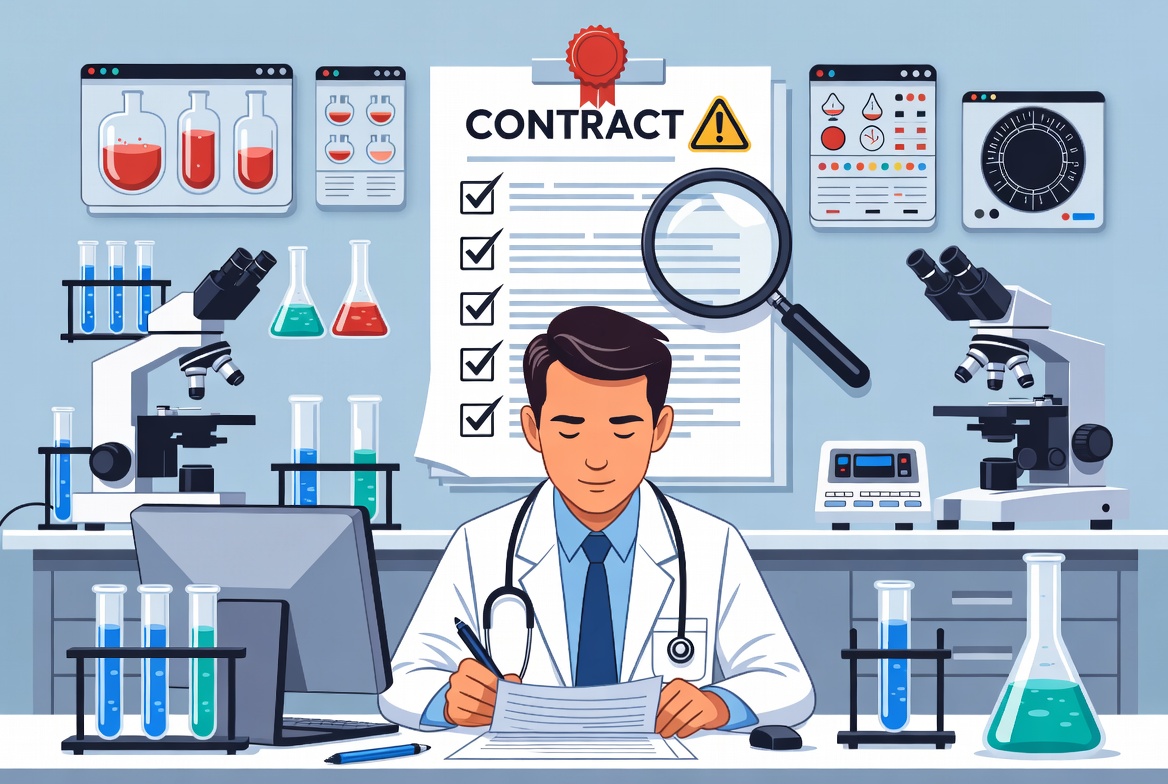
Before signing any LPO for diagnostic equipment, run through these seven questions:
Does this platform match our test menu and daily throughput?
Have we calculated the full five-year total cost of ownership?
Does the supplier have verified, local biomedical support?
Is the reagent supply chain stable and independently sourced?
Is structured application training included — and documented?
Does the equipment meet our regulatory and accreditation requirements?
Are we buying from a partner, or just a vendor?
Final Word
The best laboratory equipment decision is not the one that saves the most money on day one. It is the one that still looks smart on day one thousand — when the machine is still running, the reagents are still available, the team is still trained, and your patients are still getting results they can trust.
At Sam-Tech Diagnostics, we have been helping East African healthcare facilities make that decision for over 21 years. We do not just supply equipment. We build laboratories that last.