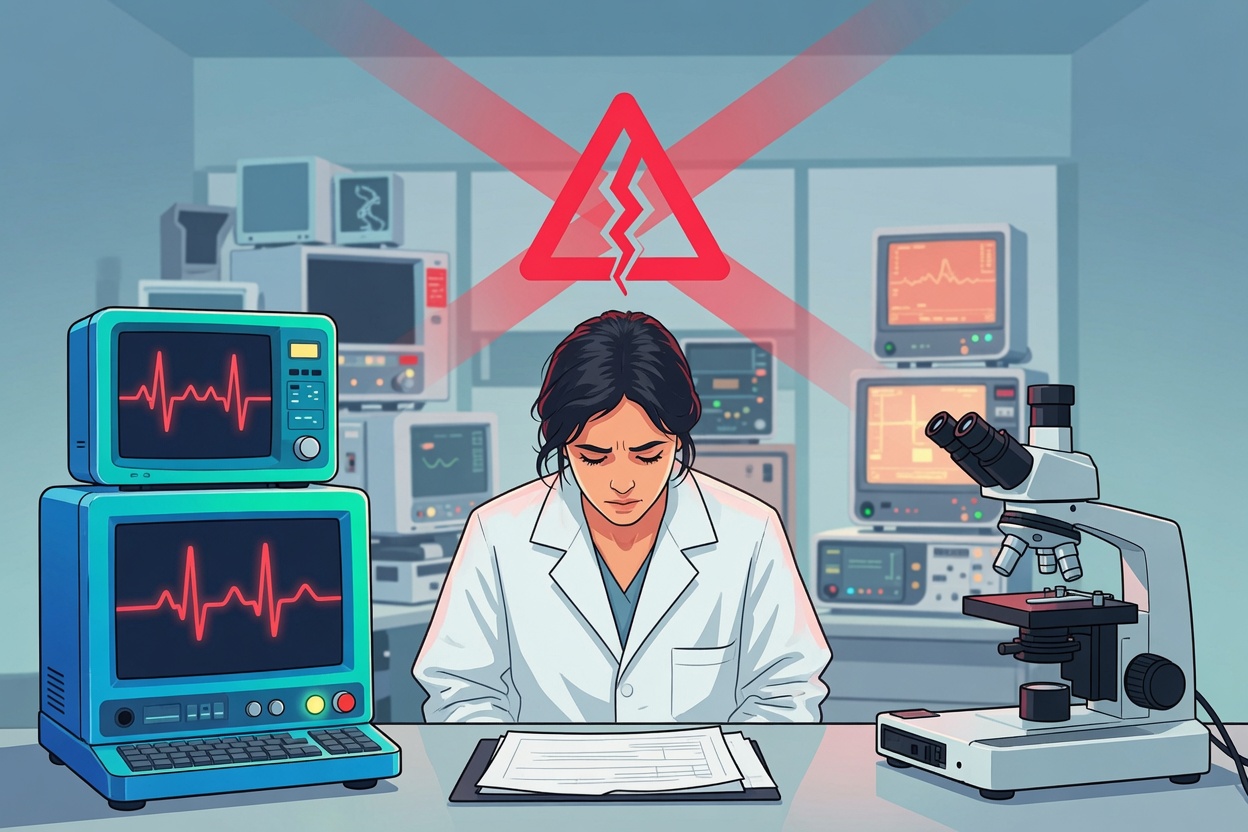
It was 7:43 AM when the hematology analyzer threw its third error code of the week. The biomedical technician had already logged a fault ticket. The reagent levels were fine. The calibration was current. But the machine simply refused to run.
By 9 AM, forty blood samples were queued. A paediatric ward nurse was calling every fifteen minutes. A surgeon had postponed an elective procedure pending a pre-op CBC. And the lab manager — experienced, competent, professional — was doing the only thing she could: apologising.
This is diagnostic downtime. And it is far more common than hospital administrators want to admit.
The Numbers Behind the Silence
Studies across sub-Saharan Africa consistently show that laboratory equipment downtime affects clinical decision-making in up to 70% of reported facility audits. Point-of-care testing (POCT) devices — blood gas analyzers, haematology counters, biochemistry platforms — are increasingly central to emergency and routine care pathways. When they fail, the ripple effect is immediate.
Delayed diagnoses. Extended hospital stays. Empirical antibiotic prescribing. Repeat patient visits. Each of these carries a financial and human cost that never appears on a maintenance budget line.
Why It Keeps Happening
The problem is rarely the equipment itself. Modern diagnostic platforms — from fully automated biochemistry analyzers to compact point-of-care units — are engineered for reliability. The breakdown happens in how facilities manage them.
The most common failure points are predictable:
Reactive maintenance culture - waiting for failure rather than preventing it
Untrained operators - running complex analyzers without formal application training
Expired or mismatched reagents - disrupting analytical performance
No service-level agreement (SLA) - meaning when breakdown occurs, response time is undefined
Each of these is solvable. None of them require a capital budget. They require a partner.
What Resilient Laboratories Do Differently
The best-performing laboratories in East Africa share a common trait: they treat their equipment supplier as a clinical partner, not a vendor. They have signed SLAs with defined response windows. Their staff receive structured application training at point of installation. They operate preventive maintenance schedules — not just reactive repair calls.
They also ask better questions at procurement:
What is the mean time between failures (MTBF) on this platform?
Who provides in-country technical support — and how fast?
What is the total cost of ownership over five years, not just the purchase price?
These are the questions that separate a good procurement decision from a great one.
The Conversation Your Facility Needs to Have
Equipment will always age. Reagents will always expire. Errors will always occur. The question is not whether your lab will face a challenge — it is whether your facility has the infrastructure, the training, and the partnerships to respond before a patient pays the price.
At Sam-Tech Diagnostics, we have spent 21 years building exactly that infrastructure across Kenya. From hematology and biochemistry to immunoassay and point-of-care, our commitment is not just to supply equipment — it is to keep it running.
Because in diagnostics, uptime is not a feature. It is a duty of care.
Sam-Tech Diagnostics Co. Ltd — Precision. Reliability. Partnership.
📍 Tatu City Industrial Park, Ruiru | 📞 +254 733 627 834