Wet or Dry Chemistry? Choosing the Right Fit for Your Lab
A doctor orders kidney function, liver function and blood sugar tests. Behind those results is a biochemistry analyser, and it works in one of two ways: wet or dry chemistry.
Both give accurate results. The difference is in how they get there, and which one suits your facility.
What’s the Difference?
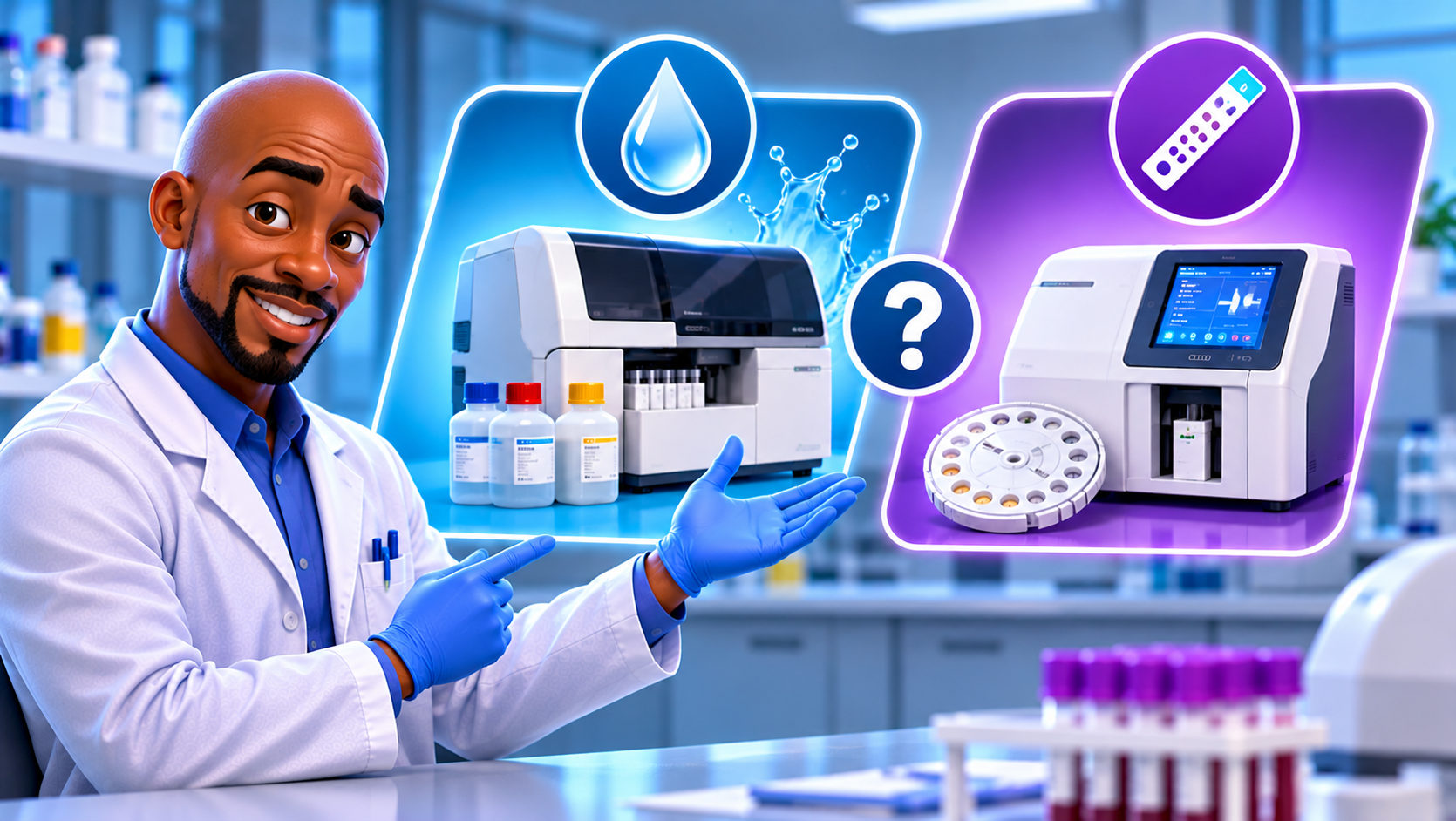
💧 Wet chemistry mixes the patient’s sample with liquid reagents inside the analyser. The machine reads the colour change and calculates the result. It’s the traditional workhorse of hospital labs.
📄 Dry chemistry uses reagents that are already built into a ready-to-use slide, strip or cartridge. You add the sample and the analyser does the rest, with no reagent mixing and very little set-up.
Think of it this way: wet chemistry is a full kitchen, while dry chemistry is a ready meal. One gives you volume and flexibility, the other gives you speed and simplicity.
When Wet Chemistry Wins
✅ High sample volumes: dozens or hundreds of tests a day
✅ Lower cost per test: the economics improve the more you run
✅ A wide test menu: from routine panels to specialised tests
✅ A dedicated lab team with time for daily maintenance and calibration
Best for: county and referral hospitals, busy private labs and central laboratories.
When Dry Chemistry Wins
✅ Low or unpredictable volumes: you only pay for the tests you run
✅ Speed and simplicity: little preparation, training or maintenance
✅ No water purification system and far fewer liquids to handle
✅ Emergencies and night shifts: ready to run at any hour
✅ Lower contamination risk: every test uses its own single-use slide or cartridge
Best for: clinics, health centres, casualty units, outreach programmes and facilities with limited lab staff.
The Contamination Factor
Contamination is one of the quietest threats to lab accuracy, and the two technologies handle it very differently.
💧 Wet chemistry reuses parts. The same probe draws sample after sample, and reaction cuvettes are washed and reused. If wash cycles are skipped or maintenance slips, traces of one sample can carry over into the next, which is called carry-over. Open reagent bottles and poor-quality water can also contaminate results without anyone noticing.
Wet chemistry is safe when it’s well looked after. That means daily cleaning, regular maintenance, quality water and reagent bottles closed and handled correctly.
📄 Dry chemistry is single-use by design. Each test runs on its own sealed slide or cartridge, which is used once and thrown away. Nothing is shared between samples, so the risk of carry-over is very low, and with no open reagents or water system, there’s less that can go wrong.
This makes dry chemistry especially useful where staff are stretched, maintenance is hard to keep up or conditions are dusty and unpredictable.
The Smart Answer: Often Both
Many hospitals now use both. A wet chemistry analyser handles the daily bulk at a low cost per test, while a dry chemistry analyser covers emergencies, night shifts and busy-day backlogs.
If the main analyser goes down for maintenance, testing doesn’t stop.
The right choice isn’t about which technology is better. It’s about which one matches your patients, workload and team.
Ask Yourself
How many chemistry tests do we run each day?
Do we have reliable water, power and trained staff on every shift?
What happens to urgent tests at 2 a.m.?
Let’s Find Your Fit
Sam-Tech Diagnostics helps Kenyan facilities choose the right biochemistry setup, wet, dry or both, backed by local engineers, reliable reagent supply and hands-on training.
👉 Book a consultation or request a quotation
📞 +254 733 627 834
✉️ info@sam-techdiagnostics.com
Sam-Tech Diagnostics: Simple, Precise & Accurate.