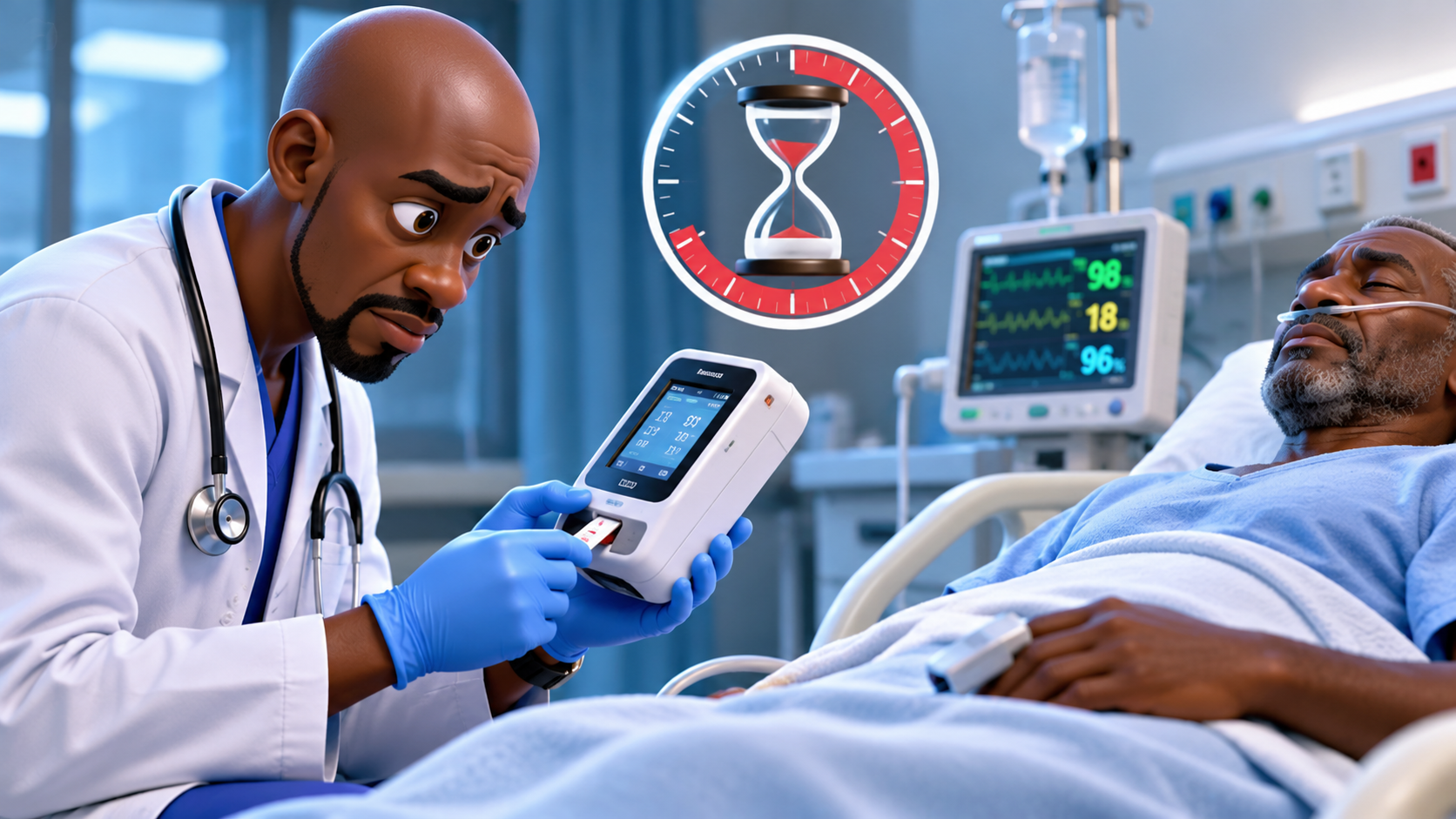
40 Minutes for a 50-Second Test
It’s 2:14 a.m. A patient in your HDU is tiring on the ventilator. The registrar needs one answer: is this hypoxia, hypercapnia, or a metabolic problem that looks like a respiratory one?
The sample is drawn in ninety seconds. Then it leaves the room.
The Analyser Was Never the Bottleneck
Ask how long a blood gas takes, and most teams quote the analysis time. That’s the shortest part.
Most of the time goes elsewhere: finding a porter, the walk to the lab, the queue, a phone call nobody answers, a value copied onto a chart by hand. Blood gas samples also spoil with delay. A delayed result isn’t just late. It may be a different result.
Forty minutes isn’t the worst case. In many facilities, it’s a normal Tuesday.
Meanwhile, the patient hasn’t paused. Ventilator settings, fluids and potassium are all being managed on judgement. Every one of those decisions can be defended, but none of them is based on the result.
Run This Audit First
You don’t need a supplier for this. You need a stopwatch and one honest week:
What is our true needle-to-number time, measured to the moment the clinician sees the value?
What is it at 3 a.m. on a Sunday?
How many ventilator adjustments last month were made before the gas came back?
If the answers make you uncomfortable, that’s your finding.
Bring the Analyser to the Patient
Point-of-care testing doesn’t replace your lab. It takes the corridor out of the critical path, so the result arrives while it’s still true.
i-SmartCare 10 is built for fixed critical-care stations: ICU, theatre, renal and NICU. It gives results in 50 seconds from 100 µL of blood. All reagents, sensors and calibration solution sit in one sealed cartridge, so there’s no fluidics maintenance. It also links both ways with your LIS/HIS, which removes transcription errors.
PocTell is built for units that move: emergency, casualty, outreach and multi-site hospitals. It reports 34 parameters in three minutes and runs 60+ tests per charge. It needs no warm-up, and its cartridges keep at room temperature for up to eight months.
Neither one is better. The right choice depends on how your unit works.
The Number That Matters
Don’t ask a supplier for their fastest analysis time. Ask: what will my needle-to-decision time be after installation?
At 2:14 a.m., that’s the difference between treating a diagnosis and treating a hunch.
Let’s Find Your Real Number
We’ll come to your facility and map your blood gas turnaround from end to end before we recommend anything. If point-of-care isn’t the answer for your unit, we’ll tell you.
👉 Book a demo or request a quotation
📞 +254 733 627 834
✉️ info@sam-techdiagnostics.com
🔗 PocTell Blood Gas Analyzer
🔗 i-SmartCare 10 Blood Gas Analyzer
Sam-Tech Diagnostics: Simple, Precise & Accurate.