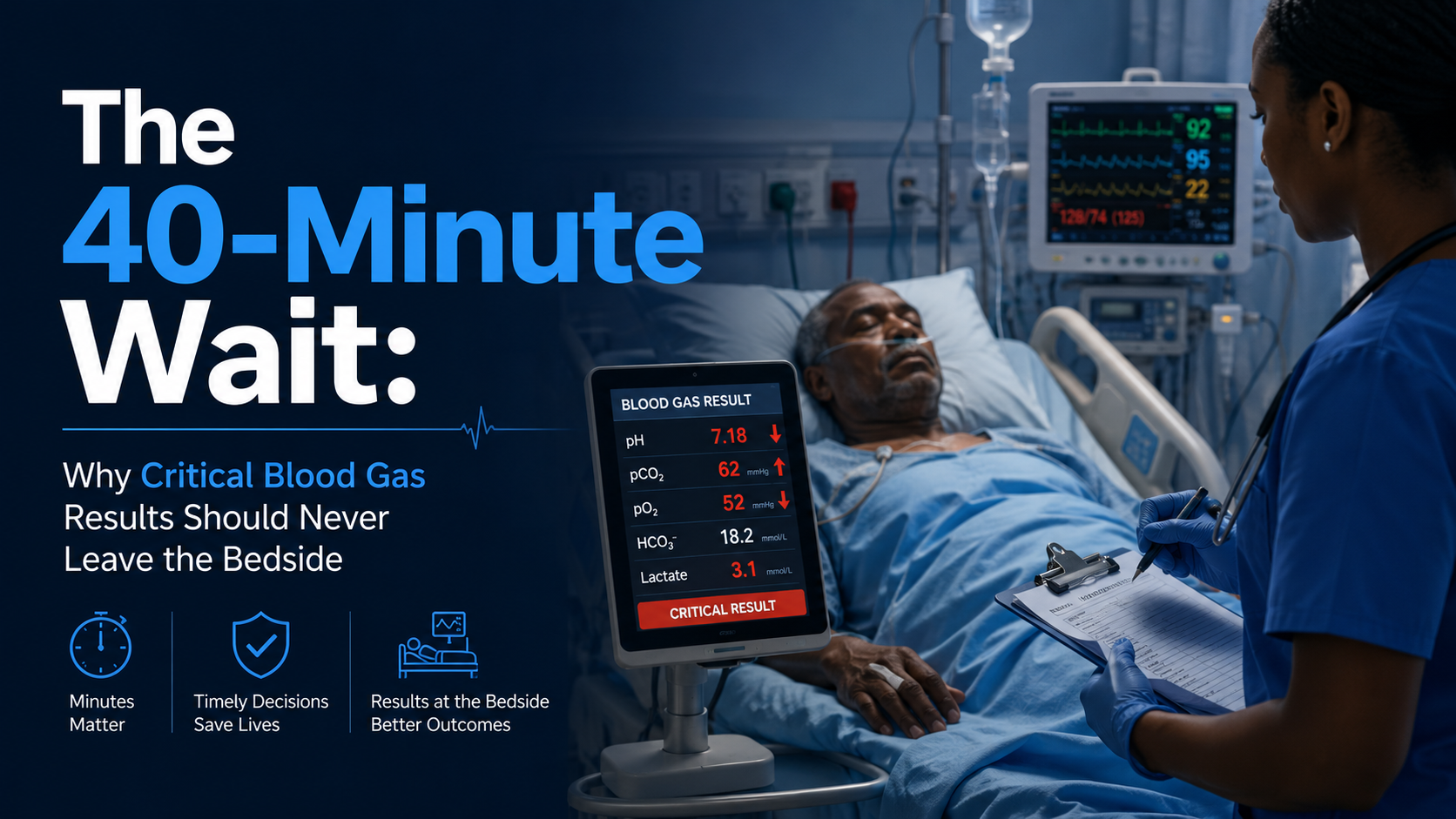
It is 2:14 a.m. A patient in your high-dependency unit is tiring on the ventilator. The registrar needs to know one thing: is this hypoxia, hypercapnia, or a metabolic problem wearing a respiratory mask?
The sample is drawn in ninety seconds.
Then it leaves the room.
The analyser was never the bottleneck
Ask most clinical teams how long a blood gas takes, and they will tell you the analysis time. But the analysis is the shortest part of the story. The real clock looks more like this:
Transit. A porter is found, or a nurse leaves the bedside. Add several minutes - more at night, more if the lab is two floors and a locked corridor away.
The queue. The sample joins whatever else arrived in the last ten minutes.
The sample itself. Blood gas specimens are perishable. Delay and temperature change the very values you are trying to measure, which is why a delayed result is not simply a late result - it may be a different result.
The return journey. A phone call that goes unanswered. A printout waiting to be collected. A value transcribed onto a chart by hand.
Add it up honestly and forty minutes is not a worst case. In many facilities, it is a Tuesday.
Meanwhile, the patient in front of you has not paused. Ventilator settings are being adjusted on clinical impression. Fluids are running on judgement. Potassium is being estimated rather than known. Every one of those decisions is defensible - but none of them is informed, and that distinction is the whole of critical care.
Run this audit before you spend a shilling
You do not need a supplier to find out whether you have a problem. You need a stopwatch and one honest week. Ask your team:
From needle to number, what is our true median turnaround for an arterial blood gas - measured to the moment the clinician sees the value, not the moment the analyser prints it?
What is that figure at 3 a.m. on a Sunday, not at 10 a.m. on a Monday?
How often does a repeat sample get drawn because the first one clotted, sat too long, or went missing?
How many ventilator adjustments in the last month were made before the gas came back?
If the answers make you uncomfortable, that discomfort is the finding. It is also, usefully, a number you can now improve.
Bringing the analyser to the patient - not the patient to the laboratory
Point-of-care blood gas testing does not replace your central laboratory. Your lab remains the backbone of your diagnostic service, and it should. What point-of-care testing does is remove the corridor from the critical path - so that in the units where minutes have clinical consequences, the result arrives while it is still true.
Two analysers we place in Kenyan hospitals solve this in different ways, and the right one depends entirely on how your unit actually works.
The i-SmartCare 10 is built for the fixed critical-care station - ICU, theatre, renal, NICU. It returns results in 50 seconds from 100 µL of heparinised whole blood, which matters enormously in neonatology, where sample volume is not an abstraction. Its CarePak cartridge holds every reagent, sensor and calibration solution in one sealed unit, so there is no fluidics maintenance ritual for your nurses to skip at 3 a.m. It talks to your LIS/HIS bidirectionally, which quietly eliminates the transcription error nobody logs. Cartridge menus run from a six-analyte electrolyte panel up to a full ten-analyte panel including glucose and lactate - you buy the menu you use, not the menu you might use.
The PocTell is built for the unit that moves. It reports 34 parameters - 10 measured, 24 calculated - in three minutes, runs 60+ consecutive tests on a single charge, and stores its cartridges at room temperature for up to eight months, which is a genuine operational advantage in facilities where cold-chain storage is contested space. There is no pre-heating wait: it tests on arrival. Emergency, casualty, outreach, a hospital with three sites and one budget - this is where it earns its keep.
One is not better than the other. They answer different questions, and the honest answer to "which should we buy?" begins with "walk us through your unit."
The measure that actually matters
Ask a supplier for their fastest analysis time and you will get a number. Ask instead: what will my needle-to-decision time be after installation? That is the number your patients experience. It is the number your clinical governance committee should be tracking. And it is the only number that tells you whether the equipment changed anything at all.
At 2:14 a.m., that is the difference between a clinician who is treating a diagnosis and a clinician who is treating a hunch.
Let's find your real number
We will come to your facility, sit with your critical care and laboratory teams, and map your current blood gas turnaround end to end - before we recommend anything. If point-of-care testing is not the answer for your unit, we will tell you that too.
Book a demonstration or request a quotation:
📞 +254 733 627 834
✉️ info@sam-techdiagnostics.com
Explore the analysers:
PocTell Blood Gas Analyzer → https://sam-techdiagnostics.com/products/poctell
i-SmartCare 10 Blood Gas Analyzer → https://sam-techdiagnostics.com/products/i-smartcare-10
Sam-Tech Diagnostics — Simple, Precise & Accurate.