A hospital in Nairobi bought a good analyser. Reputable brand. Competitive price. The procurement committee did everything right.
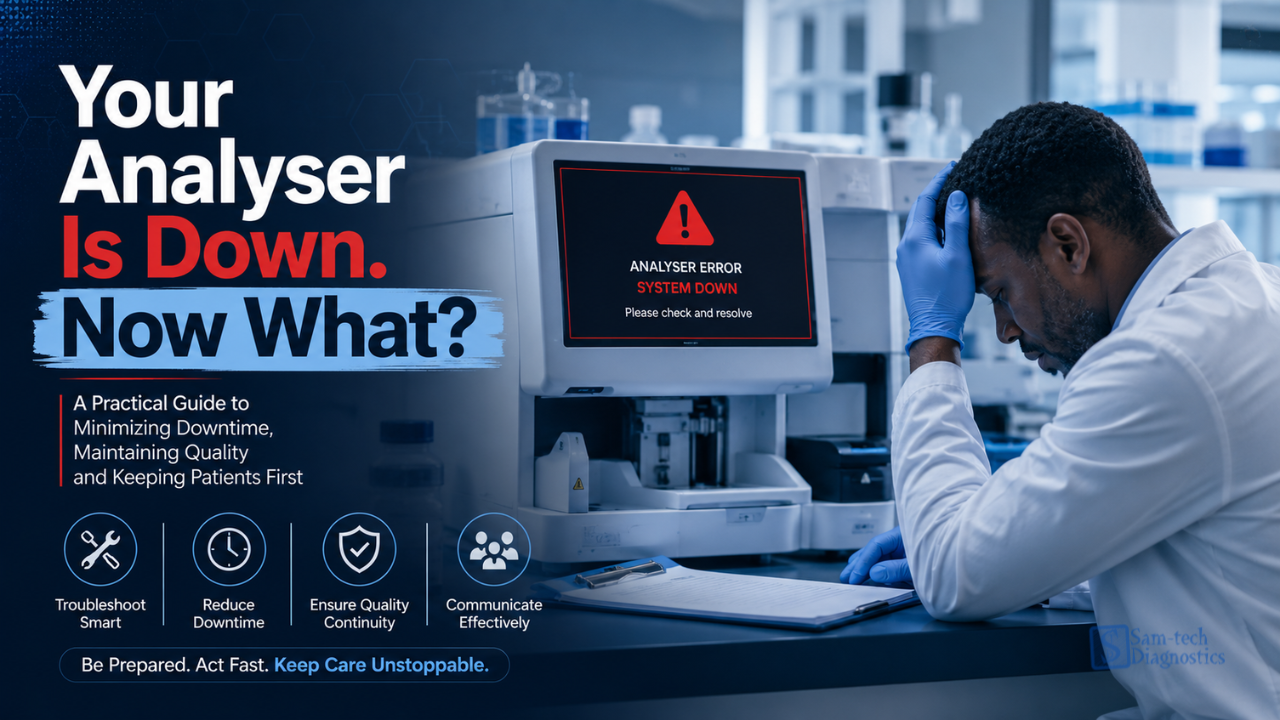
Eighteen months later, an electrode failed.
The supplier's engineer was based in another country. The part had a six-week import lead time. The reagents in the fridge had a shelf life shorter than the wait.
For six weeks, that hospital referred every one of those tests to a competitor down the road.
Some of those patients never came back.
The cost nobody puts in the quotation
Every procurement committee interrogates the purchase price. Almost none of them price the downtime. And yet, over the life of the machine, downtime is usually the bigger number.
Here is what a dead analyser actually costs you, and only the first line ever appears on a spreadsheet:
Revenue you don't earn. Every test you cannot run is income that walks out of the building.
Money you spend to replace it. Referred-out tests are billed at someone else's margin, not yours.
Reagents you already bought. Consumables have expiry dates. The clock does not stop because the machine did.
Staff you are paying anyway. Your laboratory team is on the payroll whether the analyser runs or not.
Clinicians who stop trusting you. This is the expensive one. A clinician who has been let down twice starts sending work elsewhere before the machine breaks — and that habit outlives the repair.
Patients who don't come back. The referral you made in week two becomes their new normal by week six.
And underneath all of it, the cost you cannot put a shilling against: the clinical decision that was made without the number.
Calculate your own number - it takes five minutes
Don't take our word for it. Take your own:
(Tests per day × your fee per test)
+ (Tests referred out × cost per referral)
+ (Laboratory staff hours idle × hourly cost)
= Cost of ONE day down× (Days down in the last 12 months)
= What downtime cost you last year
Now compare that figure to the difference in purchase price between the cheapest quote you received and the one with real local service behind it.
For most facilities we work with, the arithmetic ends the debate.
Seven questions to ask before you sign
Ask these of every supplier bidding for your business, including us. Ask for the answers in writing, in the contract, not in the meeting:
Where is your nearest engineer, physically? Not your head office - your engineer.
What is your guaranteed response time, and what happens contractually if you miss it?
Which spare parts do you hold in Kenya right now? Ask for the list.
What is your lead time for a part you don't hold?
How many of these exact units are installed and running in this country? An orphan model is a slow-motion downtime event.
What does preventive maintenance include, how often, and is it in the price - or is it a surprise invoice in year two?
Who trains my staff, how long, and what happens when those staff leave?
A supplier who answers these crisply is telling you they have thought about your uptime. A supplier who deflects is telling you something too.
The real product
The analyser is not the product. The result is the product - delivered every day, on the night shift, in year four, when the warranty conversation is long over.
Anyone can sell you a box. The question worth asking is who will still be answering the phone when it stops working.
Let's talk about uptime before we talk about price
Before you evaluate any analyser - ours included - come and interrogate our service capability. We would rather you asked the hard questions now than discovered the answers in month eighteen.
[X] biomedical engineers based in Kenya
[X]-hour guaranteed response commitment
Book a demonstration or request a quotation:
📞 +254 733 627 834
✉️ info@sam-techdiagnostics.com
Sam-Tech Diagnostics - Simple, Precise & Accurate.